Stress detection that asks before it decides.
Serenify notices signs of strain during the workday and checks in with the person first. What happens next is always their call.
Your camera is read, then forgotten. Only the reading is kept.
Today
Calm
Rolling 60-second window
A normal morning. Nothing to report.
Since 09:04
What serenify will never do.
Most of this product is a set of refusals. They are worth stating before anything else.
- Never
Keep your video.
Frames are sent for inference, read, and discarded. Nothing is stored, and no one — including us — can view or replay them. Only the resulting reading is kept.
- Never
Read your conversations.
What you say to Ren is yours. Companion chat, and anything you disclose in a crisis, never reaches a manager, an admin, or an employer. Not now, not ever.
- Never
Decide on your behalf.
A detection is a question, not a verdict. If you say it got it wrong, that is the end of it — the reading is set aside and nothing follows.
Three steps. The middle one matters most.
- 01
Calibration
Once, at the start, Serenify captures a short baseline of your ordinary face at rest. Every later reading is measured against your own baseline rather than against a stranger's.
- 02
The monitoring session
While a session runs, your webcam feeds a model that scores strain over a rolling 60-second window. When signals stay elevated, Serenify stops and puts the question to you. You can confirm it, wave it off, or ask to talk. Nothing moves until you answer.
The part most systems skip - 03
The weekly work-environment survey
Once a week there is a short set of questions about the work around you — workload, control, support. It is text, not camera, and it is answered in your own time.
Honest about what runs today.
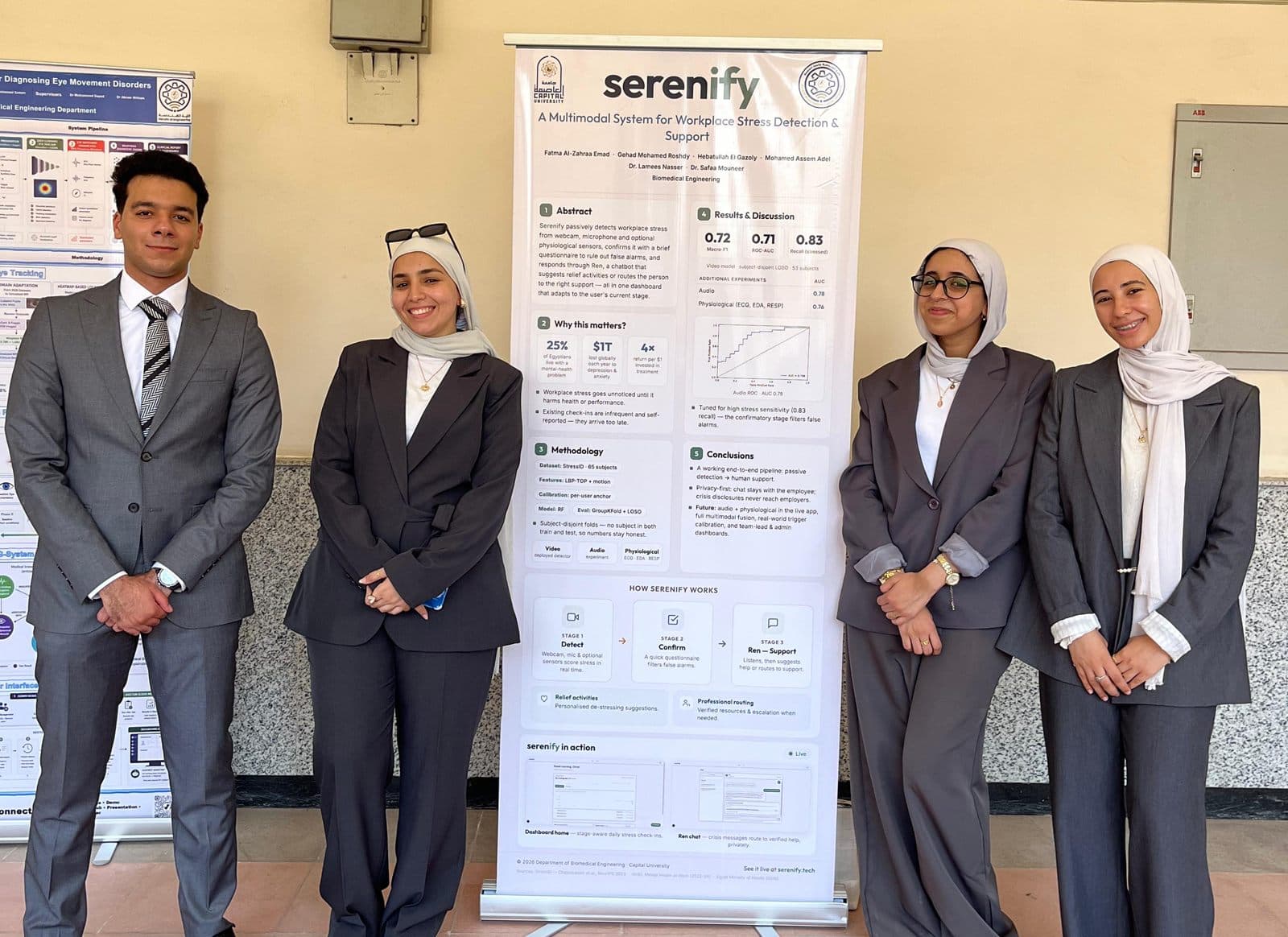
Serenify is a graduation project that is genuinely deployed. Three modalities were researched; one is in the live product.
Video
LiveThe deployed detector. Facial-texture and motion features with a per-user baseline captured at calibration.
Audio
In researchTrained and evaluated against the same subject-disjoint protocol. Not wired into the live product.
Physiological
In researchECG, EDA and respiration from the research dataset. Needs hardware most desks do not have.
Reading stress from a webcam is hard, and we will not pretend otherwise. Models trained on lab recordings meet a messier world: different lighting, different faces, different reasons for a furrowed brow. Evaluation was subject-disjoint — no person appears in both training and test — so the numbers we trust are lower than the ones we could have quoted. That difficulty is precisely why the second step exists. Asking is not a courtesy; it is the correction.
What is kept, and for how long.
Readings are kept for 90 days. Stated precisely, because the distinction matters: that is a policy, not a mechanism — no purge job runs on a schedule today, and this page does not promise one. The video they were computed from is not kept at all. The full detail is in the Privacy Policy and the Terms of Service.